

Séminaire
Tropical cyclones in a warming climate
Michael Wehner (AMCR, Berkeley Lab)
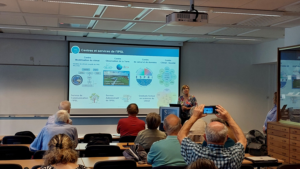
Séminaire du LMD à l’ENS.
Description
It may be obvious that tropical cyclones become more intense as the planet warms. More available energy from warmer ocean waters translates into more energy in these storms. Attribution studies confirm the harsh reality that significant changes to the most intense tropical storms have already occurred with more to come. Well established theory tells us that winds increase with tropical ocean warming, and recent observational analyses confirm this. A consequence of this increase is that tropical cyclone precipitation has increased at a rate outpacing the Clausius-Clapeyron relationship that controls changes in available atmospheric humidity. Consequently, freshwater flooding has intensified, escalating property damage and threats to human life. Saltwater flooding from storm surge most certainly also increases with global warming but significant uncertainties remain.
While these aspects of climate change are a dismal story, there still remain significant questions about other properties of tropical cyclone statistics. Most interestingly, how does warming of the ocean and atmosphere affect the frequency of tropical storms. There are two opposing views and an active scientific debate. One is that large scale ocean temperature patterns and magnitude control tropical cyclone frequency and that it will not change much or increase slightly. The other is that the small-scale disturbances, aka “seeds”, necessary to initiate cyclogenesis are the controlling factor. In a warmer, more stable atmosphere there are fewer seeds resulting in a reduced overall tropical cyclone frequency.
I will present our current observational and modeling research on the overall tropical cyclone frequency as well as the shift in the distribution of tropical cyclone wind and precipitation and the impact on the damages they cause.
Michael Wehner (AMCR, Berkeley Lab)
Informations supplémentaires
Lieu
École normale supérieure – PSL
24 rue Lhomond – aile Erasme
salle Claude Froidevaux – E314