
The role played by mangroves in the global carbon balance
DOICOM: Understanding global carbon export to coastal oceans through lateral flows from mangrove estuaries
The DOICOM project is the result of an international collaboration involving the LSCE’s OCEANIS team, which aims to accurately assess the role played by mangroves in the global carbon balance. A sampling campaign conducted in waters and sediments in Gambia and Brazil will provide a better understanding of these ecosystems, which could represent a significant fraction of carbon fluxes in coastal oceans.
Mangrove ecosystems contain 2.6 gigatonnes of carbon in their soils and roots. Part of this is released into the oceans, representing a substantial but poorly understood fraction of global carbon export to coastal oceans. These are the most productive ecosystems in terms of “blue carbon” (CO2 removed from the atmosphere and transferred to coastal ocean ecosystems).
In order to establish the global carbon balance, it is therefore essential for climatologists to understand and evaluate its terrestrial and oceanic cycles at the mangrove level. This is a difficult task due to the technical constraints imposed by these environments (limited accessibility, high variability, etc.) as well as their complexity and heterogeneity throughout the seasons.
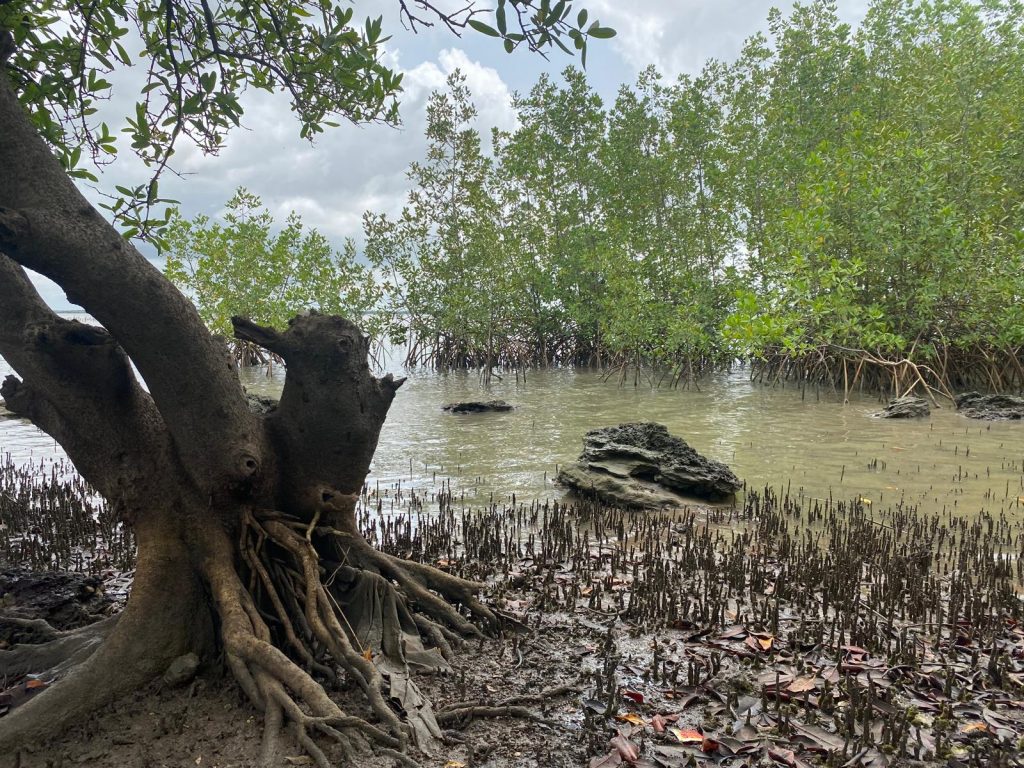
Mangroves. All rights reserved
In conjunction with the École Normale Supérieure, the DOICOM project, in which the LSCE (CEA-CNRS-UVSQ) OCEANIS team is participating, has set itself the challenge of analysing a large number of water and sediment samples taken from two mangrove ecosystems, one in Gambia and the other in Brazil. The measurements will focus on: dissolved organic carbon (DOC), dissolved inorganic carbon (DIC), alkalinity (TA) and the carbon isotope ratio 13C/12C (noted δ13C).
Together, these data will enable a precise assessment of carbon flows from mangroves to the coastal ocean, the role these ecosystems play in ocean acidification, and finally an understanding of their seasonal fluctuations.
More
A 36-hour field campaign, with sampling every two hours, took place in mid-November in the Santa Cruz Canal, Brazil, along with monthly sampling that will continue until 2026 as part of the CHEMTRAIL project (CNRS-LEFE). The DOICOM project is a collaboration between the LSCE (CEA, CNRS, UVSQ), the ENS, the LMD (France), the CEAB-CSIC (Spain) and is carried out within the framework of the LMI TAPIOCA IRD-MARBEC (France), the UFPE and the UFRPE (Brazil). It is funded by the Pierre-Simon Laplace Institute.
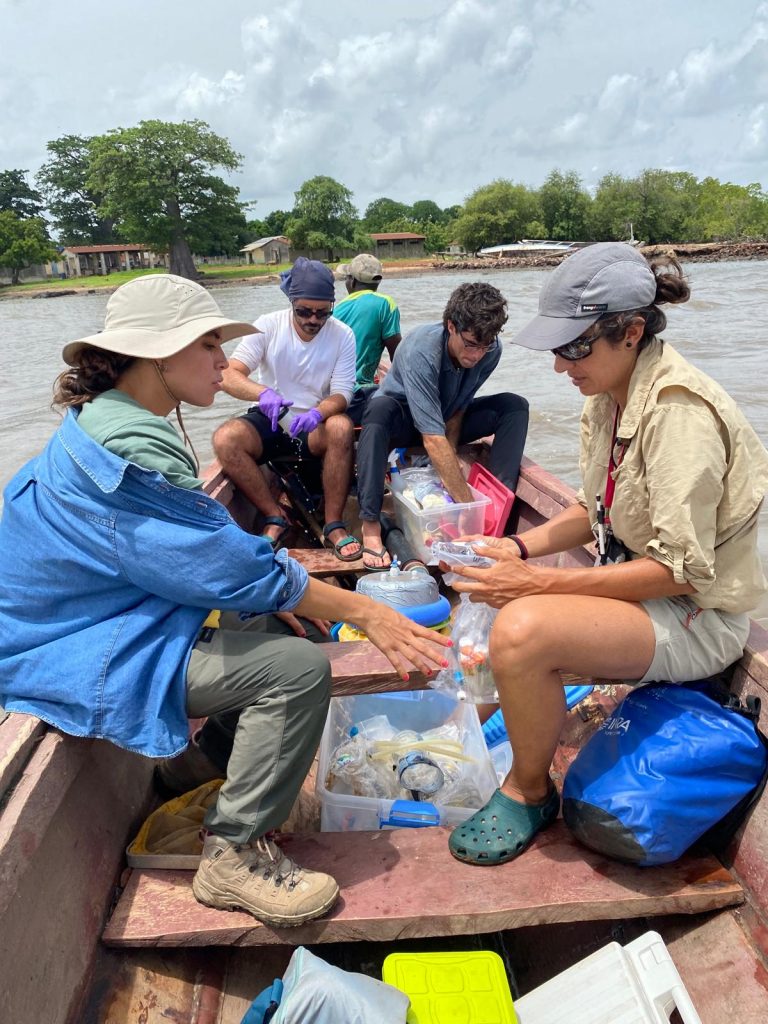
The team. All rights reserved
Contacts
Source: LSCE-IPSL.