

Rethinking the study of living organisms to understand the planet
What if understanding how the Earth works required us to rethink the way we study life? In an article published in Cell, an international team1 proposes a new discipline: ‘Planetary microbial systems biology’ (PMSB). It views the planet’s microbiomes as an interconnected system, in which interactions between microorganisms and with their environment give rise to major planetary ecosystem functions.
From molecules to ecosystems: a change of perspective
For more than four billion years, microorganisms have been diversifying and becoming increasingly complex, whilst transforming the planet. This invisible world comprises prokaryotes, whose cells lack a nucleus; micro-eukaryotes, microscopic organisms whose cells possess a nucleus; and viruses. They alter the chemistry of the atmosphere, the oceans and the soil, and play a central role in major biogeochemical cycles, such as those of carbon and nitrogen, which involve the circulation and transformation of these elements between living organisms and their environment.
However, the concepts and methods of ecology and biology have been developed based on the study of macro-organisms – primarily terrestrial animals and plants – and a few model organisms. In their article published in Cell, the scientists propose a shift in perspective through PMSB, a ‘global-scale microbial systems biology’.
This approach takes molecules and cells as its units of analysis within a continuum of microbiomes: microbial communities and their habitats are considered in terms of their connections across the oceans, sediments, soils, the atmosphere and the macro-organisms that host them.
The first step is to explore, through biomes – the major ecological systems characterised by their environmental conditions and forms of life – the genes, molecules, cells and collective behaviours that link them to one another and to their environment. The aim is then to understand the biological mechanisms at work on a global scale and to predict how they will respond to environmental changes, whether natural or caused by human activities.
A first demonstration on a European scale
In practice, PMSB combines molecular and cellular biology, multi-omic approaches, artificial intelligence and predictive modelling, as well as field observations and experimentation. Multi-omic approaches make it possible to study several components of living organisms – such as DNA, RNA, proteins and small molecules produced by cells – in conjunction. Predictive modelling uses this knowledge and these data to anticipate the behaviour of the systems under study. The whole approach is based on open, standardised data shared on a global scale.
However, this approach faces several forms of fragmentation – conceptual, scientific, technological, logistical and political – which all constitute barriers to planetary biology.
The team also presents the TREC (Traversing European Coastlines) initiative, which is one of the first implementations of this vision. It integrates field observations, experimentation and modelling to understand the organisation and dynamics of living systems at the interface between land and sea.
Conducted from Finland to Greece and involving more than 90 institutions from 30 countries, the joint TREC/Tara Europa expedition explored 115 land-sea transects – routes along which samples link terrestrial and marine environments. It enabled the collection of over 70,000 samples using standardised protocols, covering the molecular, cellular and ecological scales.
By bringing together biology, Earth sciences, ecology and data science, TREC thus offers a unique framework for quantifying the effects of anthropogenic pressures – that is, those linked to human activities – on ecosystems. It also aims to unravel the dynamics of microbial biodiversity and to develop a mechanistic and predictive understanding of how the terrestrial, coastal and marine continuum functions: understanding the mechanisms at play in order to better anticipate their evolution.
International coordination to monitor, protect and restore
The implementation of the PMSB requires international scientific coordination, based on mobile laboratories, experimental facilities such as ecotrons, and federated networks that enable protocols to be standardised and data to be shared. Ecotrons are facilities in which ecosystems can be studied by controlling environmental conditions, such as temperature, humidity or atmospheric composition. Such facilities must be supported by long-term, open and equitable programmes and funding.
In turn, a predictive understanding of microbial systems will enable us to better monitor, protect and restore ecosystems, particularly in the face of climate change. It may contribute to the development of new bioindicators (biological characteristics that provide information on the state of an environment) and bioremediation strategies, which utilise the capabilities of living organisms to reduce or eliminate pollutants, whilst taking into account the complexity of living systems.
The PMSB could thus place cells at the heart of our understanding of how the Earth works and of strategies aimed at preserving its balance in the long term.
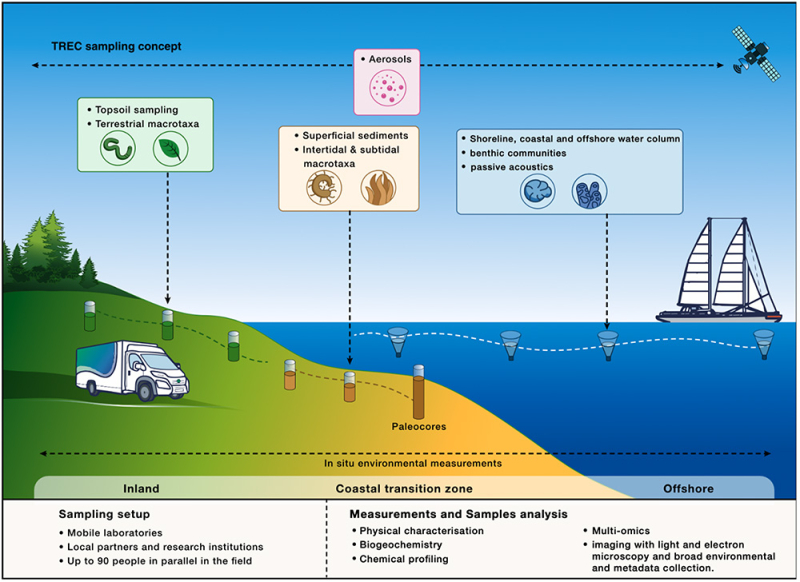
To pave the way for planetary biology, the TREC/Tara Europa expedition carried out a multi-omics exploration of highly diverse yet interconnected ecosystems (soils, sediments, aerosols, waters) across 115 land-sea gradients along the European coastline. The simultaneous deployment of mobile laboratories on land and at sea (using the schooner Tara), together with collaboration with marine laboratories in the 30 countries visited, enabled the measurement of microbiomes across national borders, across different biomes, and across biological, spatial and temporal scales, as well as natural and anthropogenic environmental gradients. © Paola Bertucci/EMBL
%More
1 An international team comprising the CNRS (France), the CEA (France), the EMBL (Germany), the ENS-PSL (France), the Tara Ocean Foundation (France), King Saud University (Saudi Arabia) and the University of Tartu (Estonia).
Reference
Peer Bork, Chris Bowler, Leho Tedersoo, Michael Kuhn, TREC Consortium Coordinators, Samuel Abiven, Colomban de Vargas, and Paola Y. Bertucci – Toward planetary microbial systems biology
Cell, 29 octobre 2026 DOI: 10.1016/j.cell.2026.09.019
Contacts
– Colomban De Vargas, directeur de recherche CNRS •
– Samuel Abiven, enseignant-chercheur à l’École normale supérieure – PSL •
Source: CNRS Biologie.