

Origin, evolution, and fate of Titan’s polar clouds
In an article published in the journal Nature Communication on December 4, 2025, a French scientific team modeled for the first time the complete seasonal cycle of polar stratospheric clouds on Titan, Saturn’s largest moon. This work explains 40 years of observations of these clouds, opening up new perspectives for understanding the evolution of Titan’s atmosphere and surface, and makes it possible to anticipate the appearance of a new polar cloud in 2027 and shed light on future exploration missions, notably Dragonfly.and the fate of Titan’s polar clouds.
Titan, Saturn’s largest moon, has an atmosphere unique in the solar system, characterized by complex chemistry and active meteorology. Since their discovery in 1980 by the Voyager probe, Titan’s polar stratospheric clouds have intrigued scientists. Although observed repeatedly by ground-based telescopes and by the Cassini mission between 2004 and 2017, their formation and seasonal evolution remained poorly understood until now.
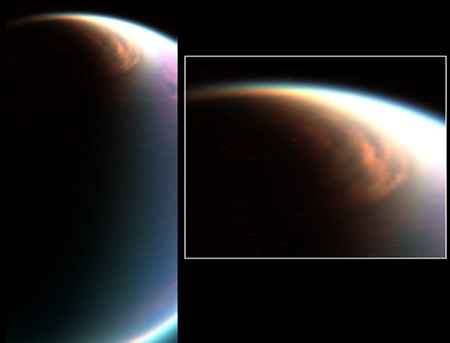
Observation of the gigantic cloud over Titan’s north pole. © NASA/JPL/University of Arizona
Thanks to the new Titan Global Climate Model, developed on the same principle as the climate models used to study global warming, researchers from the University of Reims Champagne-Ardenne, Sorbonne University, and the Paris-PSL Observatory have succeeded in reproducing the entire life cycle of these clouds for the first time. Their work shows that polar clouds form in the fall, under the combined effect of rapid cooling of the atmosphere and an enrichment of organic compounds within the stratospheric polar vortex. Initially located at very high altitudes (around 336 km), these clouds, composed of benzene (C6H6) and hydrogen cyanide (HCN) ice, gradually sink to lower layers of the atmosphere, undergoing chemical changes over the seasons before disappearing in the spring. The model also makes it possible to link observations, particularly those made in 2006 and after 2012, by interpreting them as different phases of the same seasonal cycle in both hemispheres. Researchers also predict the formation of a new polar cloud in the northern hemisphere towards the end of 2027.
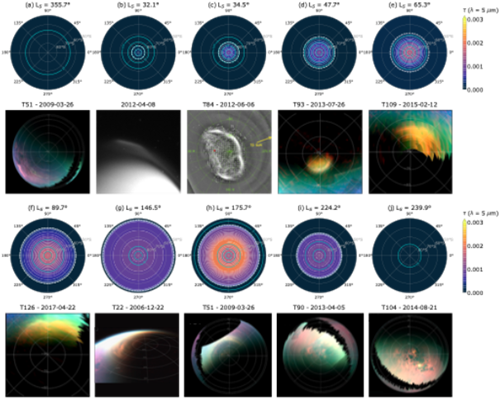
Simulation of Titan’s polar clouds compared to actual images taken by the Cassini mission, showing the evolution of the clouds at different times of the Titanian year. All rights reserved
In the longer term, these clouds could play a major role in the evolution of Titan’s surface and the composition of its polar lakes, depositing significant amounts of organic compounds through precipitation. These results provide an essential predictive framework for preparing and interpreting future observations, particularly those from the Dragonfly mission, which will explore Titan’s surface starting in 2034.
More
Reference
de Batz de Trenquelléon, B., Rannou, P., Lebonnois, S. et al. Origin, evolution, and fate of Titan’s polar clouds. Nat. Commun. 17, 250 (2026). https://doi.org/10.1038/s41467-025-66955-7
Contacts
Bruno de Batz de Trenquelléon (ex-LMD), Observatoire de Paris-PSL •
Sébastien Lebonnois, LMD-IPSL •