

In Siberia, thawing permafrost transfers significant amounts of carbon to lakes
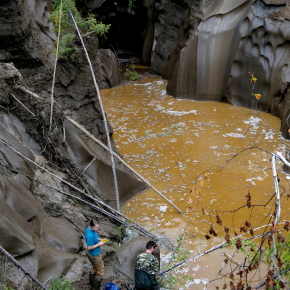
Scientists from the international PRISMARCTYC project conducted field campaigns in Central Yakutia. The scientists analyzed the concentrations and origin of dissolved and particulate organic carbon in thermokarst lakes to visualize these transfers. To understand the impact of permafrost thaw, the scientists selected several types of lakes: recently formed thermokarst lakes (<50 years old) and ancient thermokarst lakes (several thousand years old). In addition, the scientists studied certain ancient lakes that have recently been affected by permafrost thawing through the formation of recent landslides on their banks.
A field study in Central Yakutia
Global warming is occurring three to four times faster in the Arctic than the global average. Permafrost—soil that has been frozen for at least two consecutive years—can be very rich in ice and organic matter. One of the consequences of global warming is the thawing of this permafrost, leading to land subsidence and the formation of “thermokarst” lakes. This thawing can also lead to the introduction of organic carbon into these lakes, which can be converted into greenhouse gases (carbon dioxide, methane) and re-emitted into the atmosphere. However, the extent and forms of organic carbon transfer from permafrost, in dissolved or particulate form, remain poorly understood, particularly in the vast region of Central Yakutia (Eastern Siberia), which has been little documented to date.
Unprecedented concentrations of dissolved carbon
The results indicate unprecedented concentrations of dissolved organic carbon reaching several hundred mg/L in recent lakes and ancient lakes affected by landslides. Up to 75% of this dissolved organic carbon comes from thawing permafrost. Conversely, particulate organic carbon is mainly produced within the lakes themselves and is not transferred from frozen soils.
A major finding: not all carbon is converted into greenhouse gases
Some of the dissolved organic carbon is converted into carbon dioxide and methane. However, a groundbreaking finding of the study shows that a significant fraction of ancient organic carbon transferred to lakes is not converted into greenhouse gases. Thus, the thawing of permafrost causes a change in the carbon cycle in lakes. This study of a large number of lakes demonstrates the diversity of processes occurring in the Arctic due to permafrost thaw. These results provide essential information for better integrating thermokarst lakes into global climate models and better anticipating the feedbacks between global warming and the Arctic carbon cycle.
More
CNRS Laboratories
– Géosciences Paris-Saclay (GEOPS-IPSL)
– Centre de Recherche sur la Biodiversité et l’Environnement (CRBE)
– Laboratoire des sciences du climat et de l’environnement (LSCE-IPSL)
Reference
Ollivier, S., Séjourné, A., Hatté, C. et al. Massive concentrations of old dissolved organic carbon from Yedoma thaw in lakes in Siberia. Commun Earth Environ 7, 200 (2026).
Support
This work was funded by grants from ANR MOPGA (ANR-17-MPGA-0014) and ANR PRISMARCTYC (ANR-21-SOIL_0003_01) as part of the “Investissements d’Avenir” program. It also received support from the Pierre-Simon Laplace Institute (Water Cycle theme).
Contacts
– Sarah Ollivier, laboratoire Géosciences Paris-Saclay (GEOPS – OSUPS) •
– Antoine Séjourné, laboratoire Géosciences Paris-Saclay (GEOPS – OSUPS) •
– Laure Gandois, Centre de Recherche sur la Biodiversité et l’Environnement (CRBE) •
Source : CNRS Terre & Univers.