

Fertilising the ocean with iron: the impasse of large-scale trials
Ocean iron fertilisation: in a commentary, an international team led by LOCEAN-IPSL argues that larger-scale, longer-term sea trials would be unable to measure either the method’s effectiveness in terms of climate change or its impacts.
The need to remove CO₂ from the atmosphere in order to meet climate targets is reviving interest in iron fertilisation of the ocean, which aims to stimulate photosynthesis in phytoplankton in iron-deficient waters. In Dialogues on Climate Change, Buesseler et al. (2026) call for a new generation of ocean trials, larger in scale (covering more than 1,000 km2) and longer in duration (3 to 6 months) than those conducted to date. In a commentary published in the same journal, an international team led by LOCEAN-IPSL argues that these trials cannot resolve the two key uncertainties underlying public decision-making: the effectiveness and safety of the method.
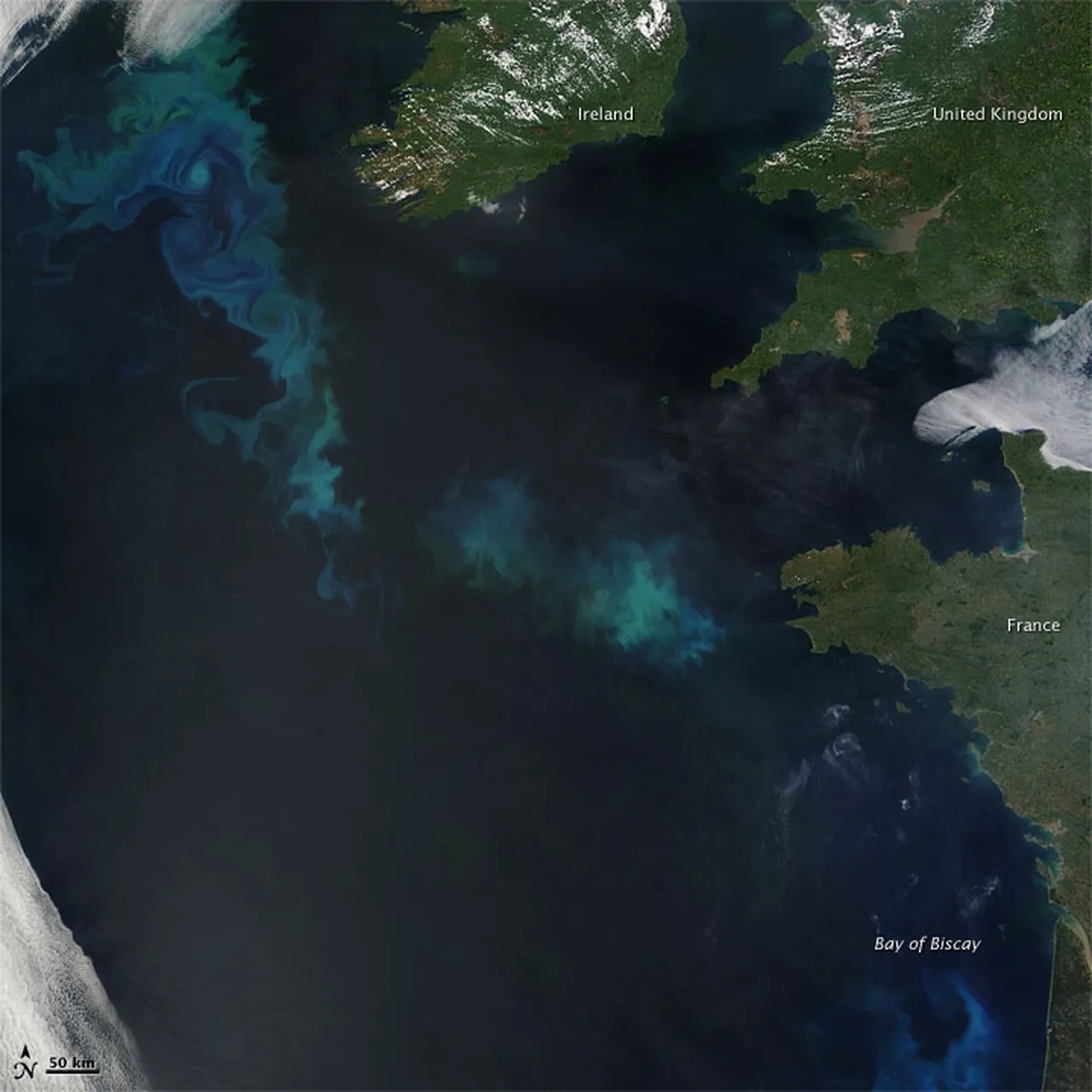
Phytoplankton blooms (in blue-green) in the North-East Atlantic, off the coasts of Ireland, the United Kingdom and France, as seen from space by a NASA satellite. © NASA Earth Observatory
The authors point out that, of the thirteen experiments carried out since the 1990s, only one has clearly shown that some of the stimulated phytoplankton sank, carrying carbon down into the depths. Even in this case, the benefit to the climate is not guaranteed: the carbon must remain there, without currents bringing it back to the surface within a few decades; the ocean must draw CO2 from the atmosphere; and the fertilisation must not deprive other regions of the nutrients they need. These mechanisms play out on a global ocean scale and over centuries, beyond the scope of an experiment lasting just a few months. The same applies to risks, such as a decline in oxygen at depth, which would only become apparent in the event of large-scale deployment.
The interpretation of these trials would therefore depend on numerical ocean models – the very ones whose gaps they were supposed to fill. However, these models unanimously conclude that the method would remove very little CO2 from the atmosphere. According to the authors, the resources devoted to such trials would be better spent on improving the models, by using dedicated observations to target the processes that govern carbon storage in the ocean. This knowledge will be essential for predicting the ocean’s response to climate change.
More
Reference
Poupon, M. A., Gray, P. C., Tagliabue, A., Cullen, J. J., Shaked, Y., Bourdin, G., Karp-Boss, L., Schofield, O., Fennel, K., Bopp, L., Lévy, M. & Boss, E. (2026). The case against renewed ocean iron fertilization field trials. Dialogues on Climate Change. https://doi.org/10.1177/29768659261498319