

A synthesis of ocean CO2 data syntheses
A summary of databases and products derived from models dedicated to oceanic CO2 was published this month in the ESSD journal. This catalogue brings together information from 73 products, including the INSU’s SNAPO-CO2 database at LOCEAN-IPSL and the neural model developed at LSCE-IPSL. This should enable the international community to better select and ultimately use data for research on the oceanic CO2 cycle and its coupling with the climate.
The ocean, through its capacity to absorb between 25% and 30% of anthropogenic CO2 emissions and more than 90% of excess heat each year, plays a crucial role in regulating climate change. However, uncertainties remain regarding estimates of global carbon budgets (Friedlingstein et al., 2025). Reducing uncertainties in estimates of CO2 fluxes exchanged at the air-sea interface, anthropogenic CO2 inventories in the ocean, and climate predictions is a challenge that will ultimately lead to better guidance for policy actions, or rather adaptation policies, since actions are not keeping pace. In order to correct numerical representations of the carbon cycle in ocean models or coupled climate/carbon models (such as CMIP), it is necessary to understand the dynamic, physicochemical and biological processes that govern it.
This is especially true given that a direct consequence of CO2 emissions from human activities and its absorption by the oceans leads to acidification (a decrease in pH), the impact of which on marine ecosystems, such as corals, has yet to be assessed. It should be noted that ocean acidification has recently been found to have reached a critical level, constituting the alarming threshold of a seventh indicator of global climate change (https://www.planetaryhealthcheck.org/).
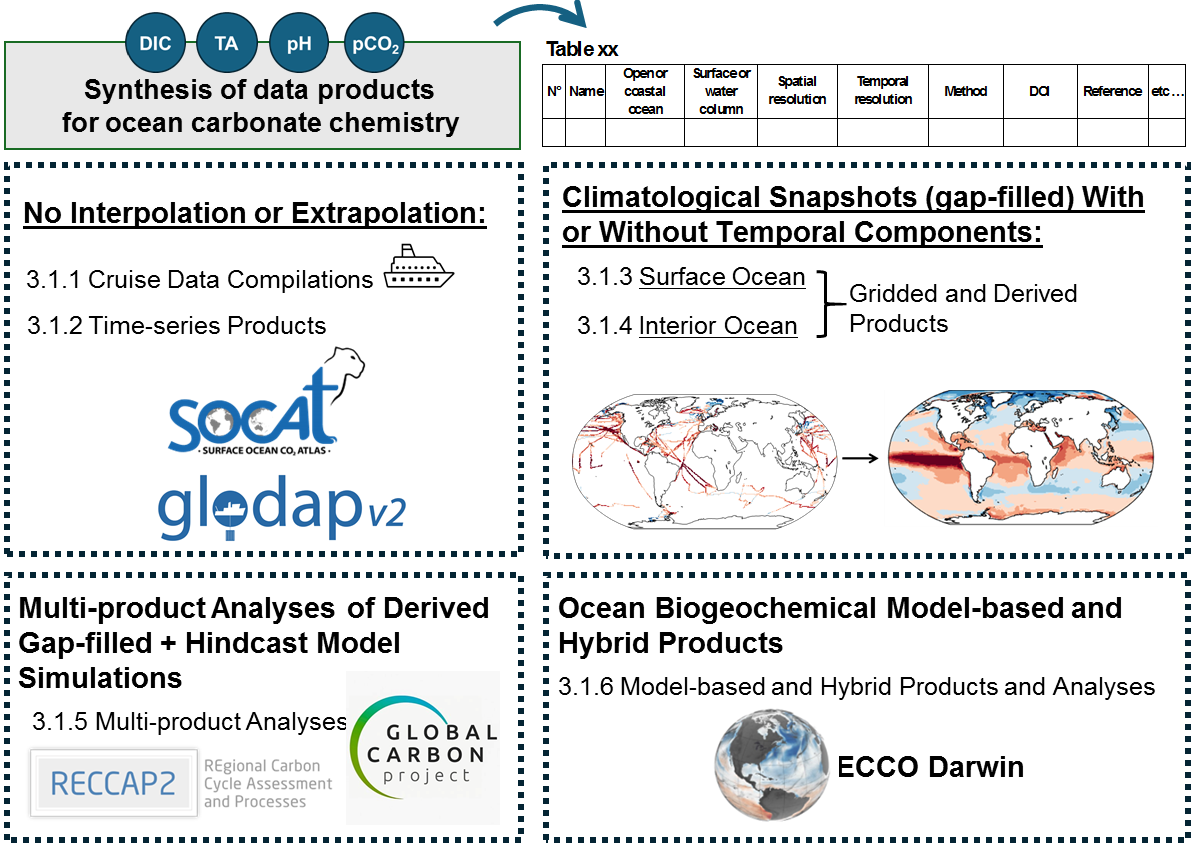
Diagram representing the information listed in the summary of products dedicated to oceanic CO2 (Jiang et al., 2026).
In this context, the synthesis work led by Li-Qing Jiang of NOAA (Jiang et al., 2026, Figure) was to compile and inform databases dedicated to oceanic CO2, including SOCAT (www.socat.info for surface CO2 fugacity data), GLODAP (www.glodap.info, for geochemical data in the water column), and the SNAPO-CO2 observation database (Metzl et al., 2024, 2025, https://doi.org/10.17882/102337). In addition to in situ observation data, the synthesis lists results derived from reconstructions (e.g., Chau et al., 2024), estimates of anthropogenic CO2 in the global ocean (Müller et al., 2023), and the results of models used in the Global Carbon Project (Friedlingstein et al., 2025), which are referenced in the IPCC’s work.
In addition to providing knowledge about the processes governing the oceanic CO2 cycle and its evolution, these databases can also be used in models to simulate Marine Carbon Dioxide Removal (mCDR) and test the potential effectiveness of geoengineering in reducing atmospheric CO2 concentrations (Report of the Academy of Sciences, 2025), which, unsurprisingly, reached record levels this year (426.8 ppm in May 2025 compared to 423.9 ppm in May 2024 on average globally). A page dedicated to the catalogue of ocean CO2 databases can be consulted at https://oceanco2.github.io/co2-products/.
More
Article
Jiang, L.-Q., et al. Synthesis of data products for ocean carbonate chemistry, Earth Syst. Sci. Data, 18, 1405–1462, https://doi.org/10.5194/essd-18-1405-2026, 2026.
Contacts
– Nicolas Metzl, LOCEAN-IPSL •
– Marion Gehlen, LSCE-IPSL •
References
– Chau, T.-T.-T., Gehlen, M., Metzl, N., and Chevallier, F.: CMEMS-LSCE: a global, 0.25°, monthly reconstruction of the surface ocean carbonate system, Earth Syst. Sci. Data, 16, 121–160, https://doi.org/10.5194/essd-16-121-2024, 2024.
– Jiang, L.-Q., et al.: Synthesis of data products for ocean carbonate chemistry, Earth Syst. Sci. Data Discuss. [preprint], https://doi.org/10.5194/essd-2025-255 , in press, 2026.
– Friedlingstein, P., et al.: Global Carbon Budget 2024, Earth Syst. Sci. Data, 17, 965–1039, https://doi.org/10.5194/essd-17-965-2025 , 2025.
– Metzl, N., et al.: A synthesis of ocean total alkalinity and dissolved inorganic carbon measurements from 1993 to 2022: the SNAPO-CO2-v1 dataset, Earth Syst. Sci. Data, 16, 89–120, https://doi.org/10.5194/essd-16-89-2024, 2024.
– Metzl, N., et al.: An updated synthesis of ocean total alkalinity and dissolved inorganic carbon measurements from 1993 to 2023: the SNAPO-CO2-v2 dataset, Earth Syst. Sci. Data, 17, 1075–1100, https://doi.org/10.5194/essd-17-1075-2025, 2025.
– Müller, J. D., et al.: Decadal trends in the oceanic storage of anthropogenic carbon from 1994 to 2014, AGU Advances, 4(4), https://doi.org/10.1029/2023av000875, 2023.
Rapport de l’Académie des sciences – 2 octobre 2025 Géo-ingénierie climatique : état des lieux scientifique, enjeux et perspectives.