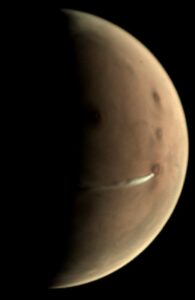


A new cloud particle formation process revealed by an extraordinary cloud on planet Mars
On some mornings, a spectacular ice cloud nearly 2,000 km long forms downwind of one of Mars’s major volcanoes. It remained impossible to reproduce in weather models until planetary atmosphere specialists realized that its formation resulted from the direct condensation of water molecules—without pre-existing dry nuclei—via a process of “homogeneous nucleation” that had never been observed before and was considered unlikely in any atmosphere, including those of Mars and Earth.
Meteorology textbooks teach us that the water-ice particles making up clouds form either through the freezing of droplets or via “heterogeneous nucleation”—where water vapor condenses onto pre-existing nuclei, such as dust particles. Although the formation of ice clouds directly from water molecules via “homogeneous nucleation” (without pre-existing particles) is theoretically possible, it is generally considered unfeasible in nature because it requires extremely high humidity levels, far exceeding the condensation point.
A study conducted by researchers from the Laboratoire de Météorologie Dynamique (LMD-IPSL, CNRS/Sorbonne Université/École Polytechnique/ENS Paris) and the Laboratoire Atmosphères, Observations Spatiales (LATMOS-IPSL, CNRS/Sorbonne University/UVSQ Université Paris-Saclay)—both part of the Pierre-Simon Laplace Institute—has revealed that the remarkable characteristics of a long Martian water-ice cloud, stretching nearly 2,000 km, could only be explained by homogeneous nucleation.
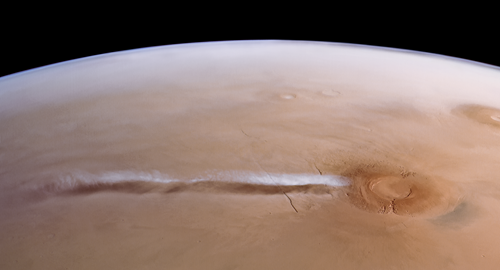
The long cloud downstream of the Arsia Mons volcano on Mars, which can be explained by a process of direct condensation of water molecules without pre-existing nuclei – a phenomenon never before observed and considered unlikely on both Mars and Earth. © ESA / DLR / FU Berlin / A. Cowart, CC BY-SA 3.0 IGO
This unique water-ice cloud forms every morning around the southern summer solstice, downwind of the large Martian volcano Arsia Mons. Following of its discovery, it was clear that this was an orographic cloud—formed, as on Earth, by cooling induced when the terrain disrupts the wind flow. However, it remained puzzling that the ice particles formed in this way did not sublimate once they moved beyond the area of disruption, remaining visible for hundreds of kilometers. Initial attempts to reproduce the phenomenon using a regional Martian meteorological model -incorporating standard equations for condensation onto dust- failed to recreate the enigmatic, elongated cloud. However, these preliminary simulations revealed that the cooling induced by the terrain was so intense that the water vapor became -locally and momentarily- extremely “supersaturated.” This state of supersaturation was too brief to allow water-ice particles to grow on dust grains, yet theoretically sufficient to enable water vapor to condense without a condensation nucleus. This process of homogeneous nucleation—occurring directly from the vapor phase—was mathematically modeled and incorporated into the meteorological simulation. An elongated cloud then formed spontaneously, exhibiting morphological and temporal evolution characteristics similar to those of the observed cloud.
For scientists, these results demonstrate that homogeneous ice nucleation from water vapor can occur in a planetary atmosphere and that the elongated clouds above the Arsia Mons volcano are a spectacular natural manifestation of this phenomenon. Meteorology textbooks will need to be updated, and one might consider the role this currently overlooked process could play in the formation of certain clouds on other planets—and on Earth in particular.
More
Reference
Jorge Hernández-Bernal, Anni Määttänen, Aymeric Spiga, François Forget. Homogeneous ice nucleation from water vapour suggested by elongated clouds on Mars. Nature Geoscience, October 7 2026. http://doi.org/10.1038/s41561-026-02089-9
Contacts
– François Forget, LMD-IPSL •
– Jorge Hernandez-Bernal, LMD-IPSL •
– Anni Määttänen, LATMOS •
– Aymeric Spiga, LMD-IPSL •