

From the fires of 2003 to the mega-fires of 2026. What lessons can we learn about the impacts of wildfires?
The Var department is one of the areas most affected by wildfires in France. However, the long-term trajectories of post-fire erosion and ecosystem restoration remain poorly understood, particularly at the catchment scale, which is the unit where runoff is concentrated across the landscape. The LSCE has just published a study carried out on three micro-watersheds of the reservoirs in the area known as ‘Peguières’, situated in the Estérel massif, which was entirely affected by the fires of 1987 and 2003 (a landmark year in France, with 61,424 ha of land affected by forest fires; source: Base De Données sur les Incendies de Forêt en France (BDIFF)).
Leur faible superficie (< 40ha), leur topographie escarpée, la forte connectivité entre les versants incendiés et les réservoirs favorisent un transfert rapide des sédiments, permettant de documenter avec précision les réponses hydro-sédimentaires face aux incendies. L’approche développée dans ce travail, est basée sur l’analyse d’archives sédimentaires, couplée à des analyses multi-proxies (géochimiques, physiques, et granulométriques). Contrairement aux approches classiques limitées à des observations de courte durée et dépourvues de références pré-incendie, cette méthode a permis de reconstruire les phases de l’avant, le pendant et l’après-incendie sur près de cinq décennies, offrant ainsi une vision intégrée de l’évolution des flux sédimentaires et de la résilience des écosystèmes.
Ces travaux ont permis de mettre en évidence le rôle central des incendies de forêt dans la modification des transferts de matière au sein des bassins versants méditerranéens, en soulignant que leurs effets s’étendent bien au-delà des perturbations immédiates (e.g. destruction de la végétation). Dans un premier temps, les résultats montrent que les incendies entraînent une augmentation marquée de l’érosion, dont l’intensité dépend des caractéristiques locales des bassins versants (topographie, couverture végétale, propriétés des sols, connectivité du réseau hydrographique et pratiques de gestion post-incendie).
 |
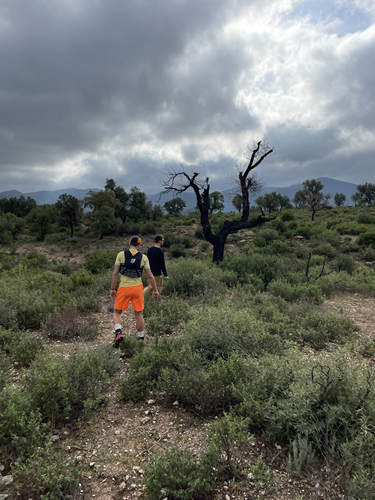 |
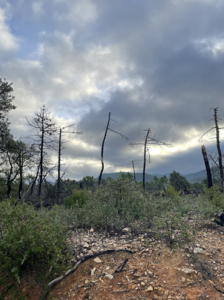
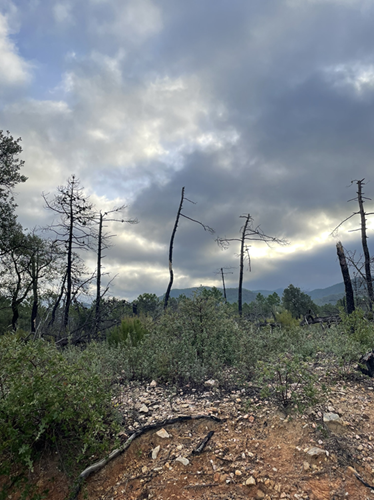
| Burned forests in the Var, October 2024. © Olivier Evrard | |
This immediate erosive response highlights significant spatial variability across the sites studied, despite comparable geological and climatic conditions. In the longer term, resilience trajectories differ according to fire history. Catchments affected by the 2003 fire and sharing the same fire history show a similar trend, with erosion rates remaining above pre-fire levels twenty years after the fire, indicating a failure to return to initial conditions. In contrast, the catchment that was primarily affected by the 1987 fire follows a different pattern, with a gradual decrease in erosion rates forty years after the fire, suggesting a return to pre-fire conditions.
These findings challenge the consensus that Mediterranean ecosystems consistently return to their pre-fire functioning within the first decade following a fire event, and show that a return to the initial pre-fire dynamics can take several decades. They thus highlight that the resilience of catchment areas depends heavily on local conditions and on the interactions between geomorphological processes, vegetation regeneration and post-fire management practices. Beyond their impact on sediment fluxes, these erosive processes also influence the transport of other substances associated with mobilised particles, notably organic matter and contaminants accumulated in soils and vegetation. Thus, post-fire erosion is a key process linking the physical transformations of catchments to the biogeochemical changes observed in these environments.
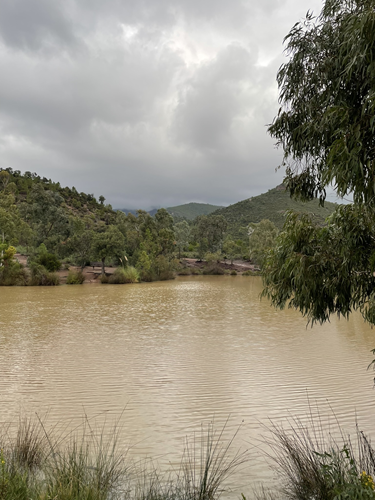 A lake rich in sediment in the Estérel. © Olivier Evrard |
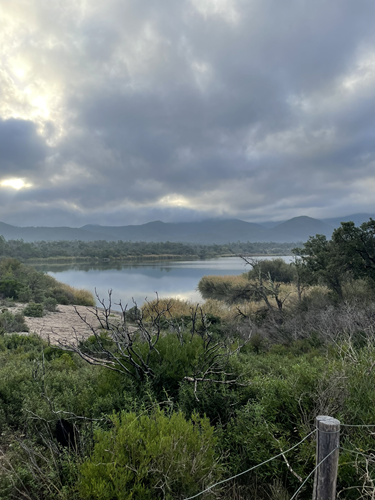 Lake Escarcets. © Olivier Evrard |
Taken together, these findings highlight the significant impact of wildfires on Mediterranean ecosystems and underscore the need to strengthen strategies for prevention, firefighting and post-fire management. Beyond the tragic events of summer 2026 and against the backdrop of global warming, projections indicate that forest fires will pose a major environmental and socio-economic challenge over the coming decades. The increase in the frequency and severity of fires, driven by the combined effects of climate change and human activities, makes integrated risk management at national level essential. Indeed, the fires currently raging in Gironde and the Fontainebleau forest illustrate that this issue no longer concerns only the Mediterranean regions, but the whole of mainland France. By highlighting the persistence of the long-term effects of wildfires, this study provides original insights into the recovery trajectories of catchment areas, which may prove useful in adapting management policies and limiting the impacts of major socio-environmental crises in the face of a risk that is set to intensify.
More
Reference
Ducruet, R., Foucher, A., Vallet, L., Mouillot, F., Chaboche, P.A., Lefèvre, I., Evrard, O. (2026). Record of Soil Erosion Dynamics: Pre- and Post-Wildfire Observations derived from sediment core analyses in Contrasting Ecosystems (Var, Southern France). Geomorphology 503, 110278.
Contacts
Romain Ducruet, LSCE-IPSL •
Anthony Foucher, LSCE-IPSL •
Olivier Évrard, LSCE-IPSL •