

Agricultural expansion is increasing the run-off of pesticides into the Uruguay River, which drains southern Brazil
Agricultural expansion in South America has led to profound environmental changes, particularly in the Pampas – those vast expanses of natural grasslands and savannahs – and the Atlantic Forest. Despite the scale of the areas affected by these changes, the long-term effects of this expansion on the transport of sediments and pesticides in the region’s watercourses remain insufficiently documented. A study led by the LSCE and EDYTEM* has made it possible to reconstruct the impact of these changes on soil degradation.
A sedimentary core was extracted from the Salto Grande dam reservoir, whose catchment area drains one of Brazil’s most productive agricultural regions, the state of Rio Grande do Sul, which ranks first and second nationally in rice and soya production respectively. This region has also undergone significant changes in land use and agricultural practices, with a shift from conventional farming to so-called conservation agriculture. This is based on the widespread adoption of direct seeding, which involves planting crops with minimal tillage whilst retaining crop residues from the previous crop to limit erosion. The sedimentary core collected was analysed using a multi-proxy approach combining radionuclide dating, high-resolution geochemical analysis, magnetic properties, sediment provenance tracing and pesticide analysis. This made it possible to reconstruct trends in sediment and pesticide fluxes for the period between 1982 and 2023 in the vast transboundary Uruguay River basin (260,000 km2), shared between Brazil, Argentina and Uruguay.
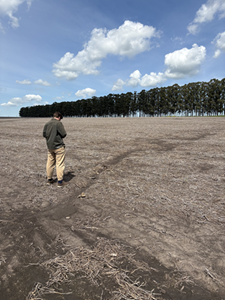 The area around the Salto Grande Dam reservoir. © Olivier Evrard |
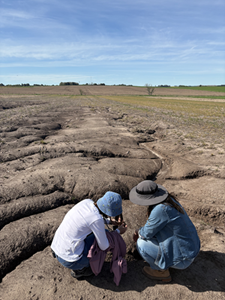 The area around the Salto Grande Dam reservoir. © Olivier Evrard |
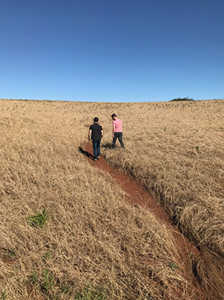 The area around the Salto Grande Dam reservoir. © Olivier Evrard |
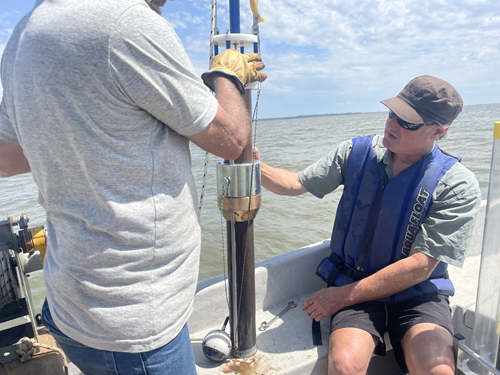 Salto Grande Dam. © Olivier Evrard |
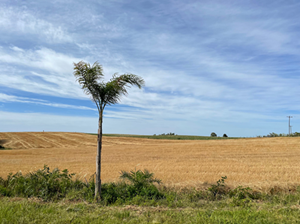 Région du réservoir du barrage de Salto Grande. © Olivier Evrard |
The results show that, since the 2000s, sediment flows have decreased by 62 per cent overall downstream of this catchment. Alongside this decrease, a shift in the dominant sources within the landscape contributing sediment to the reservoir has been observed, with a sharp increase in the contribution of the southern part of the catchment to deposits in the reservoir, rising from 40 per cent between 1982 and 2000 to 70 per cent of the flows between 2000 and 2023. These changes are consistent with the construction of dams, which have trapped sediment in the northern part of the catchment, as well as with the expected impacts of the widespread adoption of direct drilling, which may have led to a reduction in sediment flows. Furthermore, the observed shift in sediment sources is consistent with agricultural expansion, which primarily affected the southern part of the catchment during this period.
In contrast to the decline in sediment input, pesticide loads have, for their part, risen sharply in recent years (2000–2023). Several compounds detected in surface sediments are present at concentrations exceeding the reference thresholds above which it is estimated that a pesticide concentration poses a risk to communities exposed to these molecules. These results suggest a potential ecological risk to benthic communities – those groups of species living at the interface between water and sediment. These results show that direct drilling, implemented on a large scale in southern Brazil over the last two decades, has reduced sediment transport to the main dam. However, it has led to an increase in pesticide transport downstream, particularly due to their use for weed control in the absence of ploughing and the use of genetically modified herbicide-resistant seeds.
It is therefore still essential to introduce further measures to reduce these transfers of sediment and pollutants even further.
In this context, trade agreements such as those concluded between the European Union and Mercosur, and the associated increase in the area devoted to soya cultivation, could encourage further agricultural expansion and intensify the associated environmental pressures. This study therefore highlights the need to strengthen the monitoring of agricultural practices, the transfer of contaminants and their effects on the aquatic ecosystems of the Uruguay River basin.
More
* A study carried out by the Laboratory of Climate and Environmental Sciences (LSCE-IPSL) and EDYTEM in collaboration with their partners in South America (Federal University of Santa Maria, Federal University of Rio Grande do Sul, University of the Republic in Montevideo, Uruguay), France (BRGM) and Switzerland (University of Basel), as part of the international research project (IRP) CNRS CELESTE Lab (https://celestelab.cnrs.fr/) and the Franco-Swiss ANR project AVATAR (https://avatar-project.unibas.ch/en/).
Reference
Amaury Bardelle, Renaldo Gastineau, Tales Tiecher, Guillermo Chalar Mirel Cabrera, Marcos Tassano, Jean Paolo Gomes Minella, Alberto Vasconcellos Inda, Nathalie Cottin, Pierre Sabatier, Anthony Foucher, Olivier Cerdan, Christine Alewell, Olivier Evrard. Dramatic pesticide transfers fuelled by agricultural expansion in Southernmost Brazil. Journal of Hazardous Materials Advances. July 16, 2026. https://doi.org/10.1016/j.hazadv.2026.101390
Contacts
Olivier Évrard, LSCE-IPSL •
Amaury Bardelle, LSCE-IPSL •
Anthony Foucher, LSCE-IPSL •