

JIPSL contributions to the annual day of the Climate-Society Center
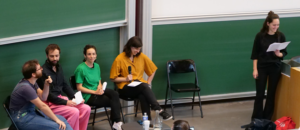
Paris, June 2, 2026. During the Climate-Society Center’s annual day entitled “Answering to Disinformation/Exploring New Narratives,” the IPSL “Jeunes Engagé·es” (JIPSL [https://www.ipsl.fr/en/sciences-society/ipsl-youth-for-climate-action-jipsl/]) was present and actively involved in a variety of creative and interactive activities!
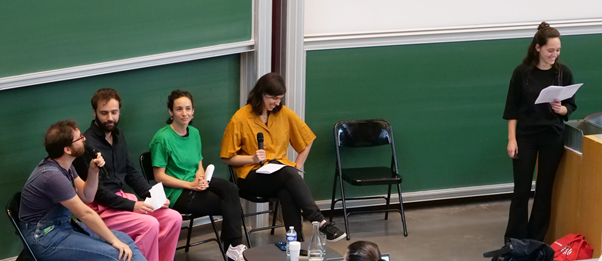
The Jeunes Engagé·es of IPSL playing fictional characters from different 2050 futures, during the show entitled “Split paths: making choices for our future” staged for the C2S annual day. © D. Peyronel et L. Chakri, ICOM-IPSL
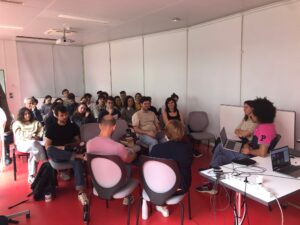
In the morning, a workshop-style presentation, created by Cécile Maguin, a research engineer at the LSCE, in partnership with Charles Terroile, a journalist at Science Feedback [https://feedback.org/fr/], set out to analyze the mechanisms of misinformation in French audiovisual media through practical case studies, and highlighted the prevalence of certain climate disinformation narratives.
While climate misinformation can be sometimes imagined as mere climate denialism fake news, today’s media misinformation primarily targets solutions to climate change, with renewable energy at the forefront [1]. During this conference, the audience was invited to comment on various TV and radio clips to identify problematic passages or mechanisms that facilitate the acceptance of misinformation: authority bias, the effect of repetition, misleading comparisons, emotional bias, and more. The audience of that day, already quite aware of climate issues, proved to be very perceptive in spotting false information and was even very amused by some of the TV clips!
During the analysis of these excerpts, it became clear that there are recurring narrative patterns that encourage inaction—patterns that could be described as counter-narratives to climate action. An inaccurate figure here, a fallacious argument there… Isolated, these single instances of misinformation may have little impact, but together—repeated in a continuous stream of information that is difficult to process and question—they shape a common perception of climate action as harmful, useless, futile… or even as a conspiracy. This was one of the main conclusions of this workshop: while new narratives are being deployed today to breathe new life into climate action [2], they will have to contend with these counter-narratives—an insidious consequence of misinformation—which are already firmly entrenched in today’s media.
This workshop came to life out of an expertise developed through several months of collaboration between Science Feedback and the “Debunking” group of JIPSL, which involved cross-checking and fact-checking cases of climate misinformation.
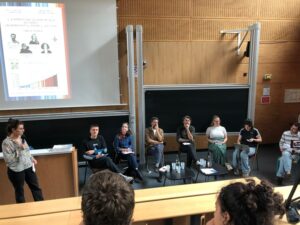
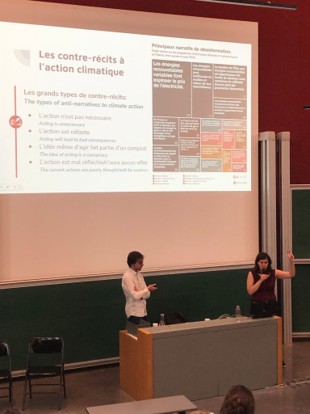 Interactive conference “How does misinformation trick us?”, led by Charles Terroile and Cécile Maguin. © Elsa Abs |
![. Figure issue de l’étude menée en 2025 par Science Feedback, Quota Climat et Data for Good, illustrant les principaux narratifs de désinformation identifiés dans les médias audiovisuels français [1]. © All rights reserved Illustration from the report of Quota Climat, Science Feedback and Data for Good on the study of 2025 media misinformation, showing the main disinformation narratives identified in French media [1]. © All rights reserved](https://www.ipsl.fr/wp-content/uploads/2026/06/jispl_narratifs-science-feedback_2juin2026.png) Illustration from the report of Quota Climat, Science Feedback and Data for Good on the study of 2025 media misinformation, showing the main disinformation narratives identified in French media [1]. © All rights reserved |
During the afternoon session, dedicated to new narratives, the JIPSL participants got creative and put on a show featuring characters from different futures that had achieved carbon neutrality, inspired by ADEME’s “Transition(s) 2050” scenarios [3] [www.youtube.com/watch?v=rDsWnhoYz2o]. This short play, titled “Split Paths: Making Choices for Our Future,” aimed to highlight the diversity of possible futures, each embodying its own values and finding happiness in its own way:
- The world of Frugalia, based on the “Frugal Generation” scenario, presents a sufficient world where customs and humanity’s relationship with nature have drastically changed.
- In Coopland, inspired by the “Territorial Cooperation” scenario, the economy has been reimagined on a more local scale, and the sharing of goods is central to how society functions.
- In the world of “Greenopoli,” or the “Green Technologies” scenario, society has instead focused on the development and massive deployment of technological solutions to make tomorrow’s world more efficient, combined with a few minor behavioral changes.
- Finally, in Gamblotron (the “Restoration Gamble” scenario)—a world whose feasibility is more uncertain—society relies on carbon capture and, more generally, on technological feats to repair the human impact on ecosystems so that it can continue on its current path of mass consumption.
The audience was invited to imagine themselves in these different visions of the future, exploring various aspects of daily life: food, housing, mobility and consumption. The audience then voted on the world they liked the best, as well as the one they thought was the most likely to come true. Surprisingly, the worlds voted as the most desirable by the audience were drastically different from those voted as the most likely. These results then fueled the debates and discussions that followed with the audience.
This mini-performance was conceived and performed by Antoine Bierjon (IPSL), Irene Dona (LSCE-IPSL), Oscar Guillemant (LISA-IPSL), Cécile Maguin (LSCE-IPSL), Diane Pacaud (LSCE-IPSL) and Elias Wolkiewiez (LMD-IPSL).
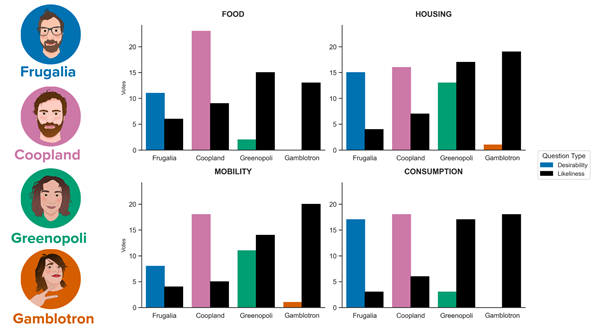
Results of the audience polls on their favorite world in different aspects of daily life, as well as the one they think most likely. In color, the votes for the most desirable world, and in black, the votes for the most likely worlds. © Oscar Guillemant
Throughout the day, the JIPSL also set up a “Wall of New Narratives,” where participants were invited to add a book, podcast, film, or other work that had made an impression on them and cast new light on the environmental cause. From scientific essays to economics podcasts, as well as utopian fictions and politically aware artists, not to mention activist comedians and original video games, the suggestions were rich and varied! The list of suggested new narratives can be found here/
https://docs.google.com/spreadsheets/d/1xOmYfo4Kv6v0gCSbQCXZggwQTaciaoKJTi3i2qcTRGA/edit?usp=sharing
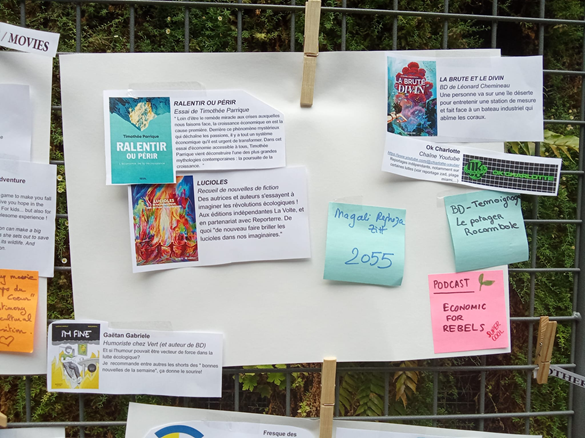
Photo of a part of the Wall of New Narratives. © Cécile Maguin
These various successful contributions to the C2S event helped reaffirm the cooperative relationship between C2S and JIPSL, and were enriching for everyone!
More
JIPSL (Jeunes engagé·es de l’IPSL)
Références
- 2026 report of Quota Climat, Science Feedback and Data for good: « Les médias à l’épreuve de la désinformation climatique » https://quotaclimat.org/actualites/desinformation-climatique-medias-europe-bresil/
- C2026 communication of the NODES project (Narratives Observatory combatting Disinformation in Europe Systemically): https://nodes.eu/2025-year-in-review-narrative-science-as-a-tool-for-social-repair
- Prospective study “Transition(s) 2050” of the ’ADEME
https://www.ademe.fr/les-futurs-en-transition/
Contact
Les Jeunes Engagé·es de l’IPSL (JIPSL) •