

The Appropriation of Scientific Output by Civil Society: The Example of the IPCC
This roundtable* proposes to examine scientific expertise as a form of scientists’ engagement, through the example of the IPCC, whose work occupies a central place in debates on the climate crisis. The aim will be to reflect on the role of scientific expertise as a resource for collective action, by analyzing the way in which IPCC reports are appropriated, translated, or sometimes instrumentalized by policymakers, institutions, and civil society.
This discussion will also make it possible to question the limits of expertise as a lever for action, as well as the possible—and perhaps necessary—complementarities with other forms of scientific engagement, whether pedagogical, media-related, activist, or artistic. In a current context marked by the accumulation of robust scientific knowledge and by persistent political inaction, we wish to interrogate the reasons for this gap between knowledge and action: how can we explain that the IPCC’s repeated warnings do not more systematically translate into binding decisions? Does the very functioning of the IPCC, founded on the principle of expertise that is “policy relevant but not policy prescriptive,” foster certain forms of political neutralization or diversion, for example through mechanisms such as carbon credits?
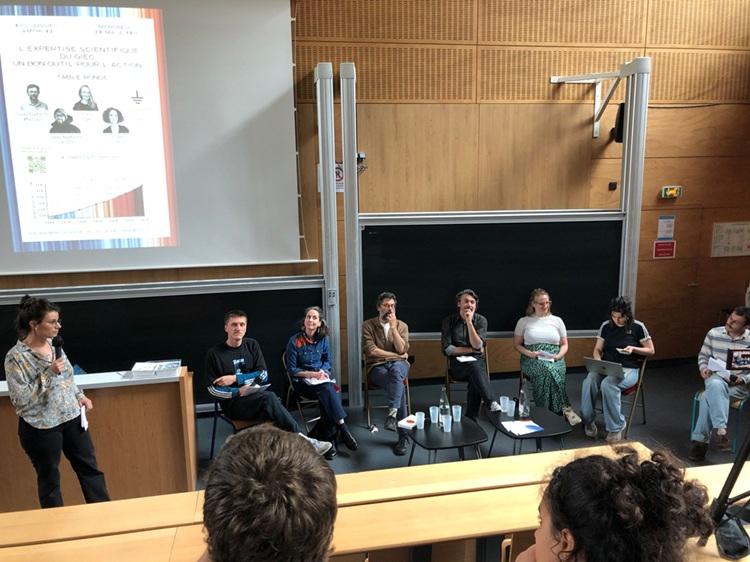
Noélie, Hugo and Thomas introducing the panellists: Christel Cournil, Jean-Baptiste Fressoz, Jean-Baptiste Sallée, Éléonore Clerc and Marcelle. © Elsa Abs
Finally, this roundtable will open a forward-looking reflection on the means of overcoming these limits: can the IPCC, and should it, evolve in its relationship to action and to civil society? What other forms of scientific engagement can complement its role, and what could we collectively put in place to strengthen the social and political impact of scientific output on climate?
Pour en savoir plus
* Organised during the annual “Climate and Society” Center Day on misinformation and alternative narratives (June 2, 2026)
https://www.ipsl.fr/en/article/the-climate-and-society-center-will-be-holding-a-one-day-event-on-misinformation-and-alternative-narratives/
JIPSL (Jeunes engagé·es de l’IPSL)
Contact