
WHIRLS: an international oceanographic campaign observes the ocean, the atmosphere and life together for the first time
Physics, chemistry and the biosphere measured simultaneously, at very high resolution, to understand how the ocean’s small-scale movements shape climate and marine life
From 20 June to 29 July 2026, two research vessels and a fleet of autonomous platforms will deploy off the coast of South Africa, in the Agulhas Current region. Their ambition is unprecedented: to observe simultaneously, and at very high spatial and temporal resolution, both the ocean and the atmosphere, covering in a single sweep their physics, their chemistry and the entirety of life, from viruses and bacteria to seabirds and marine mammals. This all-in-one approach, never before carried out on such a scale, aims to elucidate some of the most difficult-to-observe processes of the climate system. The campaign forms the heart of the European ERC Synergy project WHIRLS.
Small structures with planetary effects
The ocean is a central component of the Earth system: it absorbs most of the excess heat generated by human activities, captures a significant fraction of the carbon dioxide emitted into the atmosphere, and sustains ecosystems essential to food security, the economy and biodiversity. Yet many of the processes that regulate these functions do not occur uniformly at the global scale: they are strongly influenced by small-scale ocean movements.
These structures (eddies, fronts and filaments) extend over only a few kilometres to a few tens of kilometres and evolve over just a few days to a few weeks. Despite their small size, they play a disproportionate role: they control the exchange of heat and carbon dioxide with the atmosphere, the vertical transport of nutrients from the depths towards the surface, and the spatial and temporal organisation of marine life. Because of their transient nature and the difficulty of observing them, they remain poorly documented, and their effects are still insufficiently represented in climate models.
This is the challenge that WHIRLS (The impacts of ocean fine-scale whirls on climate and ecosystems) sets out to address, by simultaneously observing the ocean, the atmosphere and marine ecosystems, precisely at the spatial and temporal scales where their interactions are most active.
A natural laboratory off southern Africa
The campaign focuses on the Agulhas Current, one of the most powerful and energetic ocean currents on the planet. In this area, warm waters arriving from the Indian Ocean meet colder waters from the Atlantic and the Southern Ocean, generating intense turbulence, strong temperature gradients and vigorous exchanges with the atmosphere. Part of this warm water escapes into the Atlantic and feeds the great ocean circulation that redistributes heat across the planet.
In the austral winter, the period chosen for the campaign, the contrasts between ocean and atmosphere sharpen, storms are frequent and small-scale processes are particularly active. The region and the season thus form an ideal natural laboratory for studying the influence of fine-scale ocean dynamics on climate and ecosystems.
Two vessels and a fleet of autonomous instruments
The heart of WHIRLS rests on two research vessels, the Marion Dufresne (France) and the SA Agulhas II (South Africa), which operate as genuine mobile scientific observatories. Working in coordination, they will make near-simultaneous measurements over an area of roughly 200 × 200 km, exploring the three-dimensional structure of the upper 1,000 metres of the ocean and of the lower atmosphere.
Since the vessels cannot be everywhere at once, they will be supported by an exceptional fleet of autonomous platforms: underwater gliders, wave gliders, sailing buoys, around 200 surface drifters, 18 profiling floats and, possibly, Saildrone-type marine drones. Some 300 atmospheric soundings will also be carried out using radiosonde balloons and profilers, complemented by wind lidars and aerial drones to characterise the lower atmosphere. Together, this network, of unprecedented density and diversity, will make it possible to track in near real time the formation, evolution and dissipation of fine-scale ocean structures.
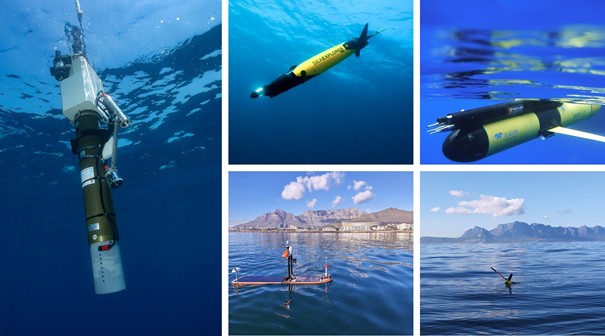
Some of the autonomous platforms deployed by WHIRLS. Left: a biogeochemical profiling float sampling the water column. Top right: a SeaExplorer underwater glider (left) and a Slocum glider fitted with a microstructure probe for measuring turbulence (right); bottom: an autonomous surface vehicle and a glider resurfacing, in front of Cape Town bay. Credits: WHIRLS project / Sean Lavis (Sea Technology Services), D. Luquet (IMEV), Alseamar, Rockland Scientific. All rights reserved
Un instrument inédit en France
Une innovation majeure de la campagne sera le MVP300, un profileur embarqué en route, premier instrument de ce type en France. Capable de sonder de façon répétée les 1 000 premiers mètres de l’océan pendant que le navire se déplace, il mesurera la température, la salinité, l’oxygène, le pH et les nitrates, révélant la structure physique, chimique et biologique de la couche supérieure de l’océan à haute résolution. Au-delà de WHIRLS, le MVP300 restera disponible pour l’ensemble de la communauté scientifique française.
An instrument new to France
A major innovation of the campaign will be the MVP300, an underway towed profiler and the first instrument of its kind in France. Able to repeatedly sample the upper 1,000 metres of the ocean while the vessel is moving, it will measure temperature, salinity, oxygen, pH and nitrates, revealing the physical, chemical and biological structure of the upper ocean layer at high resolution. Beyond WHIRLS, the MVP300 will remain available to the entire French scientific community.
A first: the ocean, the atmosphere and life measured together
What makes WHIRLS unique is that it observes, within a single campaign and at the same moment, compartments of the climate system that are usually studied separately. On one side, physics and chemistry: the exchanges of heat, momentum and gases between ocean and atmosphere, the ocean carbon pump, oxygen, nutrients and aerosols. On the other, the biosphere in its full extent: from viruses and bacteria, through phytoplankton and zooplankton, up to seabirds and marine mammals, at the top of the food chain.
Measuring these different compartments together, namely the atmosphere, the physical and chemical ocean and the whole marine biome, at very high spatial and temporal resolution is new, if not entirely unprecedented. It is precisely this simultaneity that will make it possible to connect processes observed until now only in a fragmented way: how an eddy or a front, by bringing nutrients up to the surface, stimulates phytoplankton, alters carbon uptake, and ultimately attracts predators and marine mammals, while shaping the exchanges of heat and moisture with the atmosphere above it.
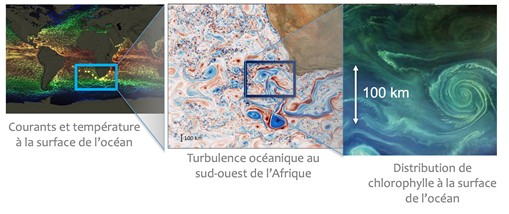
From large scales to small scales. Starting from ocean surface currents and temperature (left), the campaign zooms in on ocean turbulence south-west of Africa, in the Agulhas Current region (centre), where eddies, fronts and filaments structure the distribution of surface chlorophyll (right). Each panel covers progressively finer scales, down to features of around 100 km and below. All rights reserved
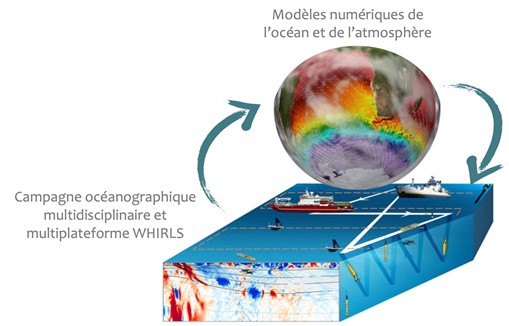
The WHIRLS observation-and-modelling concept. A multidisciplinary, multi-platform oceanographic field experiment (two research vessels, floats, gliders, drifters and drones, sampling the ocean and the lower atmosphere) is combined with coupled numerical models of the ocean and atmosphere. Together they allow WHIRLS to observe physics, chemistry and life simultaneously at very high resolution. All rights reserved
Observing life, from viruses to marine mammals
The biological and biogeochemical programme of WHIRLS is remarkable in scope. Water samples are analysed for nutrients and their isotopic composition, tracers of the physical supply towards the surface. Primary production quantifies the rate at which microalgae convert CO₂ into organic matter; flow cytometry characterises plankton communities cell by cell; plankton nets sample larger organisms; and genetic and genomic analysis finely identifies biodiversity, including viruses and bacteria that are otherwise difficult to observe.
At the larger scale, acoustic systems detect zooplankton and fish, while observers survey seabirds and marine mammals. Small-scale ocean structures indeed often create zones of high biological concentration that attract predators: tracking this dynamic from virus to mammal, alongside physics and chemistry, offers an integrated view of the marine biome that is rarely achieved.
A strategic synergy with the SWOT satellite
WHIRLS is of strategic importance to CNES and to the SWOT satellite mission, dedicated to the high-resolution observation of the ocean surface. The preparatory work carried out over the past year has shown that SWOT can resolve structures five to ten times finer than conventional altimetry satellites, and even reconstruct, for the first time, the vertical velocities of the ocean in the study region, a quantity notoriously difficult to measure.
The campaign will provide a benchmark dataset to validate SWOT’s ability to capture this fine-scale variability. One particular challenge will be the unprecedented comparison between vertical velocities inferred from the satellite and those measured directly at sea. WHIRLS follows on from the BioSWOT-Med campaign (2023), extending its results to a region with strongly contrasting physical, biogeochemical and ecosystem characteristics.
At the heart of the European ERC Synergy project WHIRLS
The campaign forms a central component of the ERC Synergy WHIRLS project (Unravelling the impact of ocean fine-scale whirls on our climate and ecosystems), funded by the European Research Council under the Horizon Europe programme (ERC Synergy Grant No. 101118693) for the period 2024-2030. The project brings together physical oceanographers, specialists in modelling and observation, and biogeochemists from Germany, France, Sweden and South Africa.
WHIRLS is led by four principal investigators (PIs): Arne Biastoch (GEOMAR, Kiel), Sabrina Speich (École normale supérieure, Paris), Sebastiaan Swart (University of Gothenburg) and Sarah Fawcett (University of Cape Town). Sabrina Speich, one of the project’s four PIs, will also serve as chief scientist aboard the Marion Dufresne during the campaign.
Beyond the European funding, the campaign benefits from decisive French support: the French Oceanographic Fleet (Research Infrastructure IR*), the CNRS (National Institute for Earth Sciences and Astronomy, INSU), the National Centre for Space Studies (CNES), the Pierre-Simon Laplace Institute (IPSL) and the Data Terra research infrastructure. The project’s French component is also led by the École normale supérieure (ENS-PSL) and the Laboratory of Dynamic Meteorology (LMD, UMR 8539).
For the first time, we are going to observe together, in the same place and at the same moment, the ocean, the atmosphere and all the life they harbour, from viruses to marine mammals. It is by bringing together these compartments, usually studied separately, that we will be able to understand how the ocean’s smallest structures act on climate and biodiversity.
Sabrina Speich, PI of the ERC Synergy WHIRLS project and chief scientist of the Marion Dufresne
A broad international collaboration
Beyond the four teams of the ERC consortium, WHIRLS mobilises a broad international partnership involving in particular South Africa, Germany, Sweden, France, Italy, the United Kingdom, China and the United States, together with numerous research institutes and space agencies. By simultaneously observing physics, biogeochemistry and ecosystems at small scale, the campaign will provide essential knowledge to improve climate predictions, better understand the ocean carbon cycle and anticipate the responses of marine ecosystems to climate change.
About the campaign
Framework
Central campaign of the ERC Synergy WHIRLS project (Horizon Europe, grant No. 101118693, 2024-2030), led by GEOMAR (Kiel), ENS Paris, the University of Gothenburg and the University of Cape Town. French support: French Oceanographic Fleet (IR*), CNRS-INSU, CNES, IPSL, Data Terra, ENS-PSL and the Laboratory of Dynamic Meteorology (LMD, UMR 8539).
WHIRLS. Unravelling the impact of ocean fine-scale whirls on our climate and ecosystems
Schedule
Main phase from 20 June to 29 July 2026, at sea off South Africa (Agulhas Current region and Cape Basin). Deployment of autonomous platforms for continuous monitoring from January 2026.
Resources
Two research vessels (Marion Dufresne, SA Agulhas II), a fleet of autonomous platforms (gliders, drifters, Argo floats, marine drones), a complete atmospheric set-up (~300 soundings, lidars, drones) and the underway MVP300 profiler.