


Temperatures on the Earth’s surface: new records broken in France in 2025
Temperatures measured in France in 2025 broke new records according to observations provided by the French IASI sounder aboard the Metop satellite. This was particularly true for surface temperatures, which are the best indicator for monitoring climate change. Unlike more traditional meteorological data, which measures temperature at an altitude of 2 metres, the observations provided by this atmospheric sounder give the same measurements as if a thermometer were plunged directly into the ground or water. And this is true on land and at sea, with an accuracy exceeding 0.1°C.
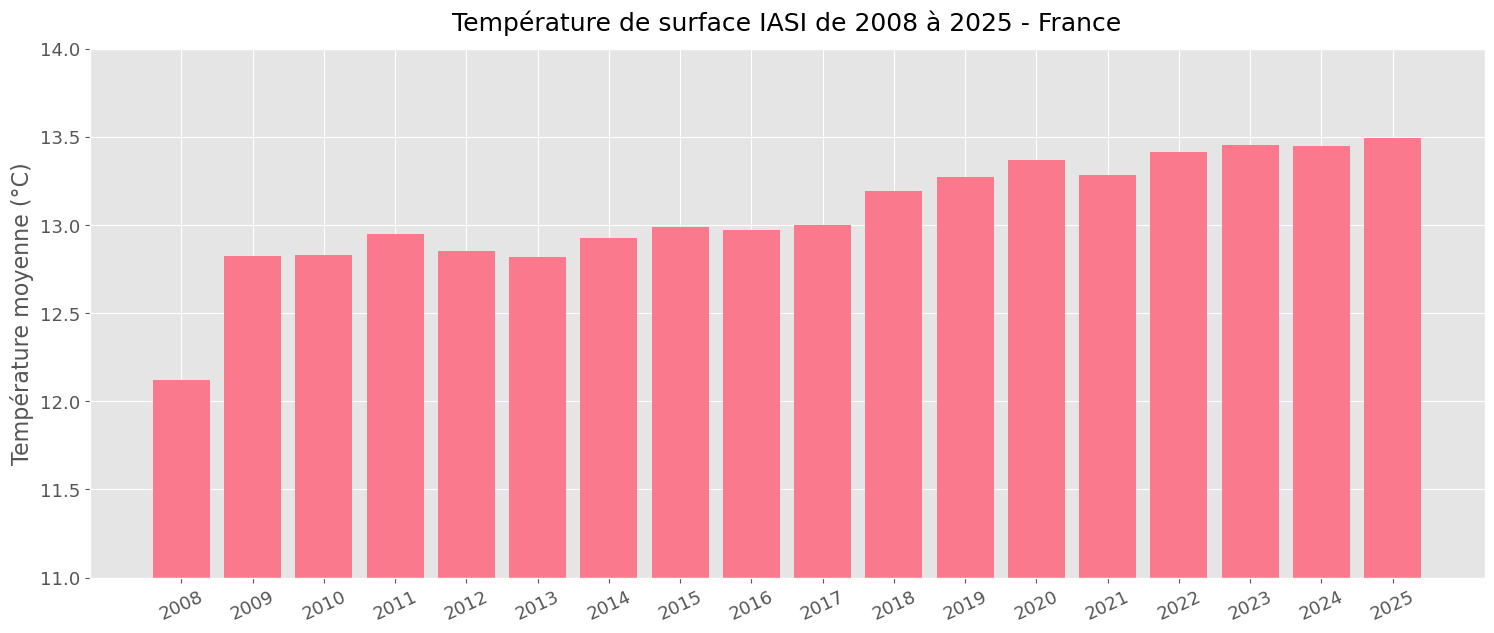
IASI surface temperature from 2008 to 2025 – France. All rights reserved
How can this continuous increase be explained when CO2 emission inventories, which is the main greenhouse gas emitted by human activities, show a steady decline in France? As CO2 remains in the atmosphere for several decades, even if emissions are falling in France thanks to efforts to burn less fossil fuels, we will still have to wait before we see CO2 concentrations in the atmosphere decline.
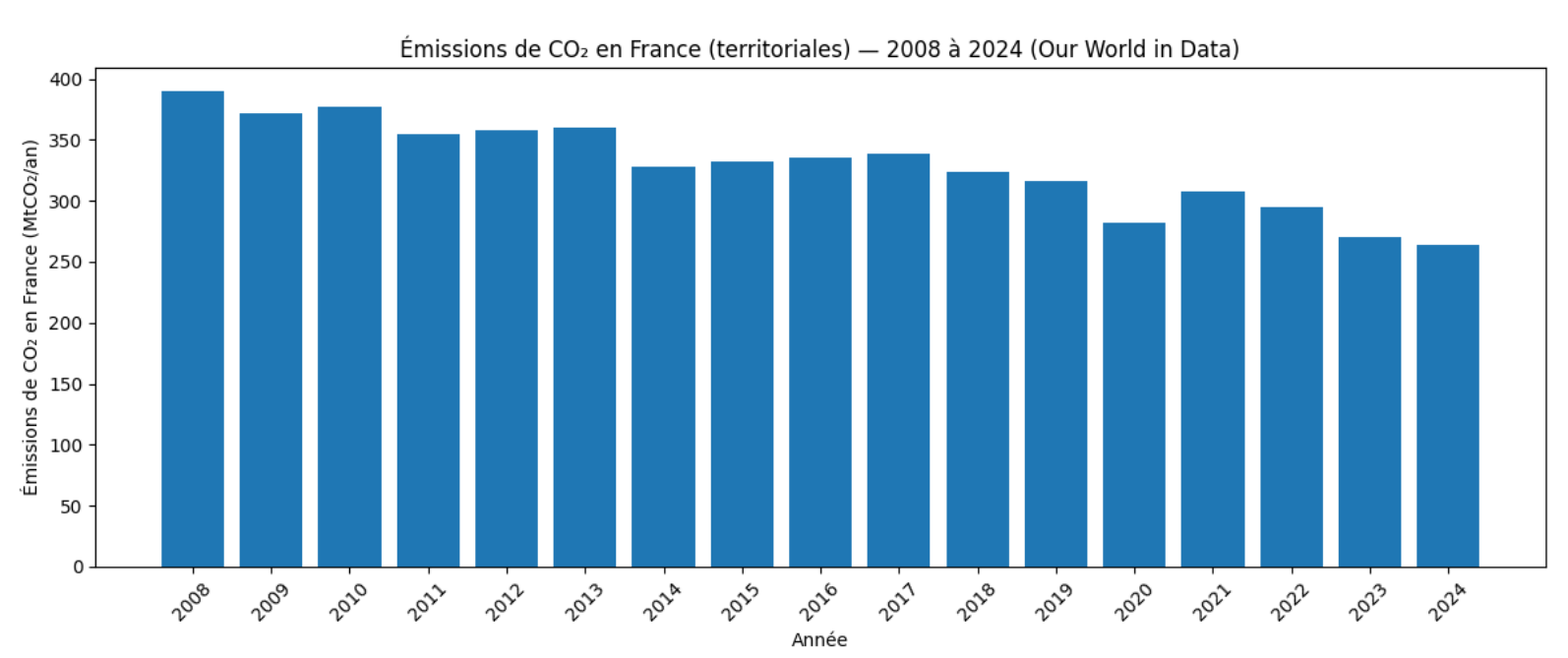
CO2 emissions in France (territorial) – 2008 to 2024 (Our World in Data). All rights reserved.
However, if we look at the entire Earth, averaging observations from the North Pole to the South Pole, the 2023 record has not been broken. This is because the El Niño phenomenon, which warms the Atlantic Ocean, has a significant influence on global temperatures: El Niño years are warmer, while La Niña years are colder.
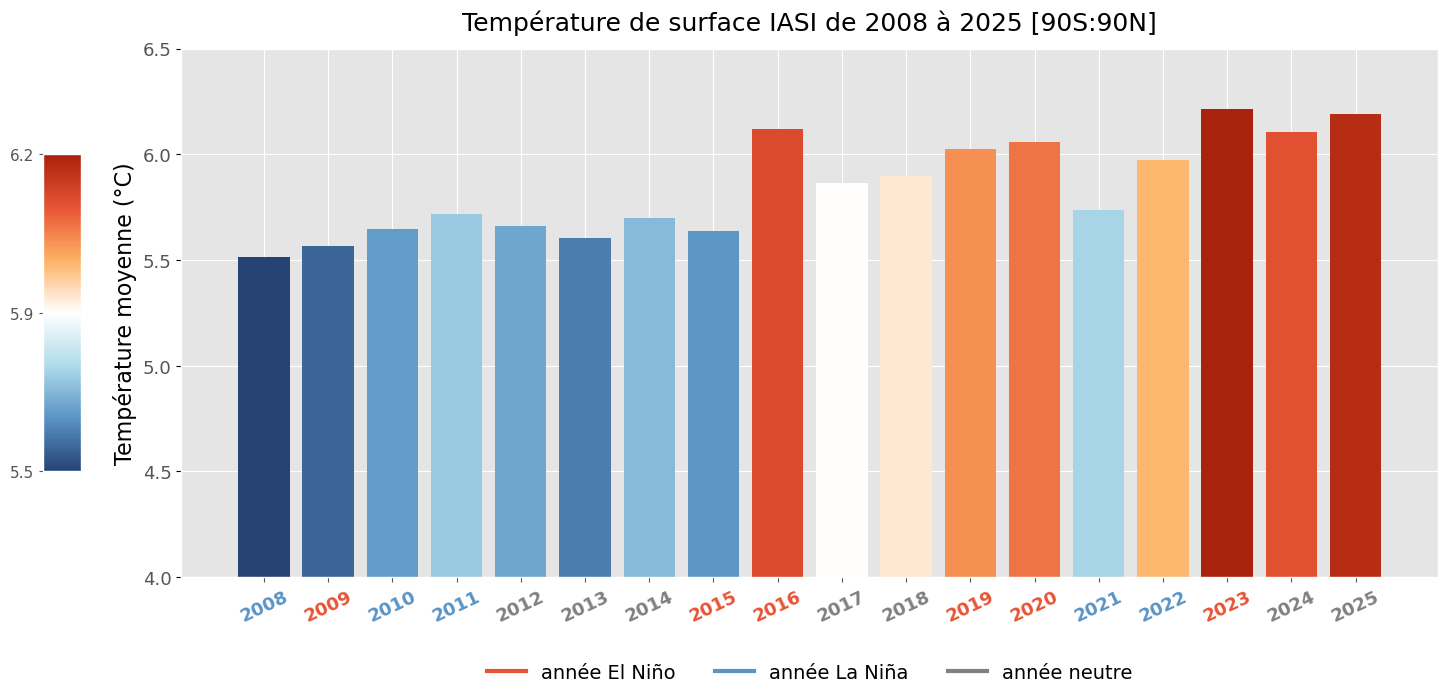
IASI surface temperature from 2008 to 2025 [90S:90N]. All rights reserved
To understand recent temperature trends, natural phenomena such as variations in solar radiation, major volcanic eruptions and the El Niño phenomenon must be taken into account. Added to this is the anthropogenic contribution linked to the accumulation of greenhouse gases. In 2025, the sun was at its peak activity in its approximately 11-year cycle, there were no volcanic eruptions intense enough to cool the atmosphere, and it was a neutral period in terms of El Niño/La Niña. However, greenhouse gas concentrations are not yet falling, despite the efforts of many countries to reduce emissions. When all these factors are taken into account, it is clear that 2025 was the second hottest year since the IASI sounder began flying.
The IASI mission, carried aboard the European Metop satellite, has been monitoring the atmosphere for over 18 years. The instrument’s stability over time is impressive, giving it benchmark status for other sounders in the same family. The satellite passes over every location and measures the temperature at the Earth’s surface during its morning pass at around 9:30 a.m. and again in the evening at around 9:30 p.m. The data is available online at https://iasi-ft.eu/products/skt/, allowing anyone who wishes to do so to calculate average temperatures and monitor changes in the Earth’s surface temperature anywhere. Continuity of measurements for the next 25 years is ensured by its successor, the new-generation IASI instrument (IASI-NG), which was launched in August by Ariane 6 and will take over to provide new data on temperature and gas concentrations in the atmosphere from 2026 onwards. A coverage period of at least two years is planned to ‘calibrate’ the instruments and verify that they are observing temperatures everywhere with the same accuracy.