

A look back at the 2022 Hunga volcanic eruption
The atmospheric impacts were revealed in a report published by APARC.
The report on the atmospheric impacts of the Hunga volcanic eruption, published by APARC, a branch of the global climate research programme, has just been announced at the AGU conference in New Orleans. Several scientists from laboratories associated with the CNRS (LATMOS, LMD, LISA LOA, LPC2E, LaCY) and the CEA contributed to this report as lead authors or contributors.
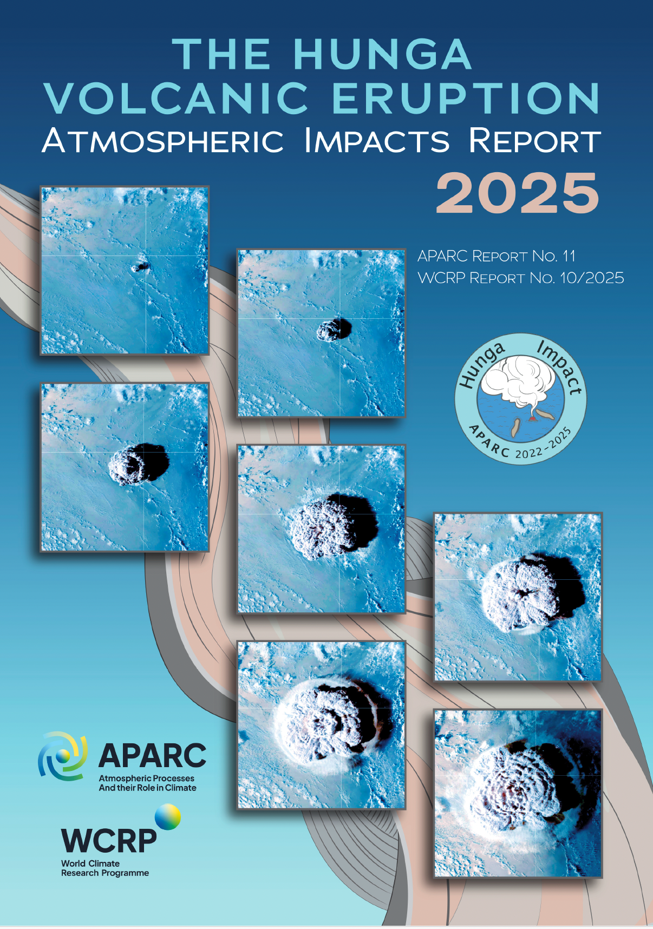
The eruption of Hunga volcano on 15 January 2022 was a high-magnitude explosive underwater eruption (Volcanic Explosivity Index 6), unique in the era of satellite observations. The highest plume reached an altitude of 58 km in the lower mesosphere. The main volcanic plume detached at 30-35 km, with a rapid descent over a few days to a layer at 26-30 km altitude.
The Hunga eruption produced a plume reaching 58 km in less than 20 minutes and short-term gravity wave and Lamb wave responses unprecedented in observations; these disturbances crossed the globe several times and extended to the top of the atmosphere (including the thermosphere and ionosphere).
The Hunga eruption increased the global stratospheric water vapour load by about 10%. Most of this water vapour remained in the stratosphere until 2025. Infrared cooling due to the water vapour from Hunga caused the initial cloud to descend to an altitude of approximately 23-27 km in mid-February 2022, where it remained for the following months.
The water vapour from Hunga caused a cooling of 0.5–1 K in the global stratosphere (50–1 hPa) during the first two years, and a cooling of 1–2 K in the mesosphere after 2023. This contrasts with previous major volcanic eruptions where aerosols caused stratospheric warming.
The SO2 emission generated by the eruption was estimated at ~20 Tg, but the shallow underwater setting eliminated most of this volcanic sulphur (~95% was diluted in seawater). Only a modest amount (~0.5-1 Tg) of sulphur dioxide was therefore transported to the stratosphere, which is an order of magnitude less than the stratospheric injection of SO2 from Mount Pinatubo.
In the months following the eruption, substantial disturbances in stratospheric ozone and associated trace gases were observed throughout the southern hemisphere. The Hunga eruption had no significant impact on the Antarctic ozone hole or on ozone in the Arctic stratosphere.
The record global surface temperatures of 2023/2024 were not caused by the Hunga eruption. The average global radiative forcing of the tropopause due to Hunga was approximately −0.4 W/m2 on average over the first two years; this cooling was mainly caused by the attenuation of solar radiation by aerosols (as the water rose to levels too warm to have an effect at the surface). The maximum cooling induced by Hunga in global surface air temperature was estimated at 0.05 K (with an uncertainty of about 50%), but this cooling is indistinguishable from background variability.
More
Reference
The Hunga Volcanic Eruption Atmospheric Impacts Report
Contacts
– Sergey Khaykin,
– Pasquale Sellitto,
– Aurélien Podglajen,
– Bernard legras,